Florida Amendment 3: What It Means for Brevard Homeowners
By Bobby Freeman, McCoy-Freeman Real Estate Group // August 29, 2026
Bobby Freeman breaks down what Brevard homeowners could actually save, and why a bigger exemption doesn't guarantee a lower bill
ABOVE VIDEO: Real Estate Expert Bobby Freeman examines Florida Amendment 3 and What It Means for Brevard Homeowners

BREVARD COUNTY, FLORIDA – A proposed constitutional amendment on the November ballot could bring meaningful property tax relief to homesteaded homeowners across Brevard County and the Space Coast, but the full financial picture is more nuanced than the headline numbers suggest.
Florida Amendment 3 would raise the homestead exemption for non-school property taxes, a change that could put real money back in the pockets of homeowners in Cocoa Beach, Cape Canaveral, Merritt Island, Satellite Beach, Melbourne, Viera, Palm Bay and Titusville.
But according to Bobby Freeman, REALTOR® with the McCoy Freeman Group at Compass, homeowners should understand both sides of the equation before assuming a bigger exemption means a smaller total tax bill.
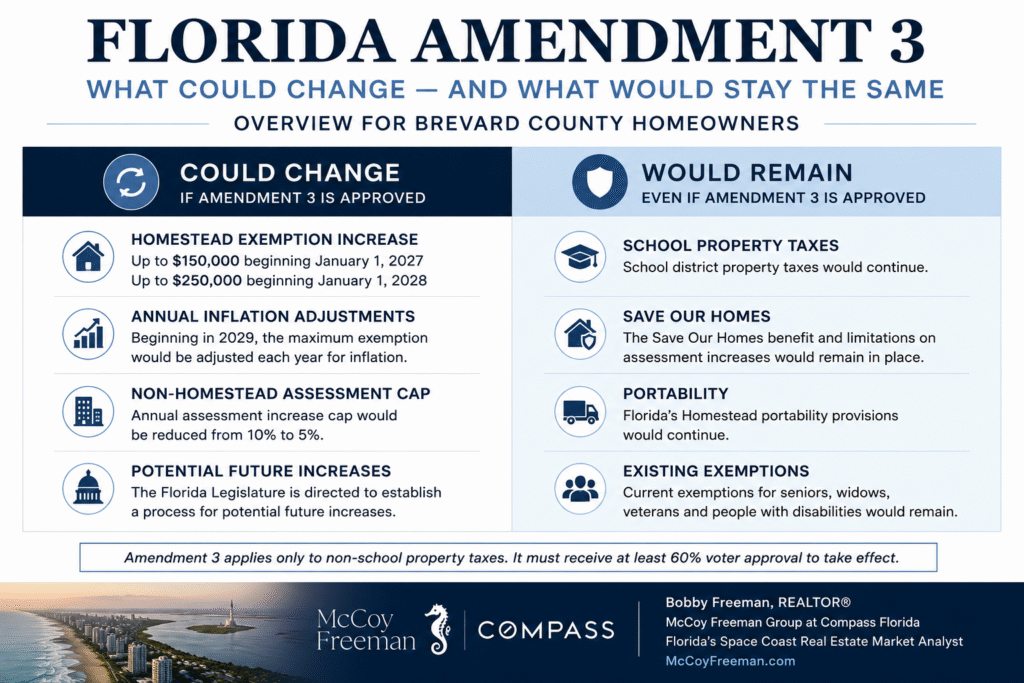
What Amendment 3 Would Actually Do
If approved by 60% of Florida voters, Amendment 3 would raise the homestead exemption from non-school property taxes to $150,000 beginning January 1, 2027, then to $250,000 beginning January 1, 2028.
Starting in 2029, that exemption would adjust annually for inflation. The amendment would also reduce the non-homestead assessment cap from 10% to 5%, while leaving school district property taxes untouched.
In practical terms, that means the tax savings apply to county, municipal and special district levies, the portion of a Brevard County tax bill that funds things like fire and police services, road maintenance and local infrastructure, not the portion that funds public schools.
What It Could Save Brevard County Homeowners
Florida TaxWatch estimates a qualifying homesteaded property could save approximately $1,035 in 2027 and around $2,085 in 2028.
Those are statewide estimates, and actual savings for any individual homeowner will depend on their property’s assessed value and the millage rates set by Brevard County and their specific city or town.
“A tax reduction on paper doesn’t automatically mean an overall financial benefit,” Freeman said. “When property tax collections go down, local governments often look at their budgets, millage rates, fees or service levels to make up the difference. It’s worth watching how Brevard County and our cities respond, not just what the exemption itself is worth.”
Freeman also points out that non-ad valorem assessments, the flat fees many Brevard County property owners already pay for things like stormwater, solid waste or fire services, would not be reduced by the homestead exemption increase.
Those assessments are billed separately from the value-based portion of a tax bill and are unaffected by Amendment 3.
Key Dates for Brevard County Homeowners
The Brevard County Board of County Commissioners will hold budget hearings on September 8 and September 22, 2026, both at 5:05 p.m.
These hearings typically offer early insight into how the county is thinking about revenue and spending heading into a year when a significant property tax change may take effect, and Freeman recommends homeowners who want a preview of local fiscal priorities keep an eye on them.
Five Questions Every Homeowner Should Ask
How much could you personally save?
The statewide averages are a starting point, not a guarantee. Homeowners should look at their current assessed value and their city or county millage rate to get a more accurate estimate of what the higher exemption would mean for their own tax bill.
How much local government revenue could be affected?
A higher homestead exemption reduces the taxable base that funds county and municipal budgets. Understanding the scale of that reduction helps explain why local governments may respond with budget or millage adjustments.
How would Brevard County and its cities respond?
Local governments facing lower property tax collections have a few levers available: adjusting millage rates, revisiting budgets, or changing fees and service levels. The September budget hearings are a good place to start watching for signals.
Could fees or assessments change?
Because non-ad valorem assessments aren’t reduced by the exemption, some homeowners may see those fees hold steady or increase even as their ad valorem tax bill goes down.
What happens with second homes or rentals?
Amendment 3’s homestead exemption increase applies specifically to homesteaded properties, meaning a primary residence with a filed homestead exemption. Second homes, investment properties and non-homesteaded rentals would not benefit from the same increase, though the reduced non-homestead assessment cap (10% down to 5%) does apply more broadly to non-homestead property.
Bottom Line
Amendment 3 represents a meaningful potential shift for Brevard County homeowners, but Freeman advises looking past the headline savings figures. “Understanding both what you could save and how local budgets might respond gives homeowners a much clearer picture heading into the vote,” he said. Homeowners with questions about how the amendment could affect their specific property or plans to buy or sell on the Space Coast are welcome to reach out directly.

Bobby Freeman is a REALTOR® and co-founder of the McCoy Freeman Group at Compass, serving Cocoa Beach, Cape Canaveral, Merritt Island, Viera, Satellite Beach and Melbourne. With a Fortune 500 marketing background and a focus on oceanfront condos, waterfront homes, luxury properties and investment real estate, Freeman and business partner Nikki McCoy Freeman lead one of the Space Coast’s top-performing real estate teams. For questions about this article or your Space Coast real estate needs, contact Bobby at 321-693-1694 or visit www.mccoyfreeman.com.