
Health First Cardiologist Dr. Kevin Campbell Talks Heart Rhythm with Eau Gallie Yacht Club Members
By Space Coast Daily // October 10, 2025
it’s vital to individualize care and meet the needs of each patient with AFib
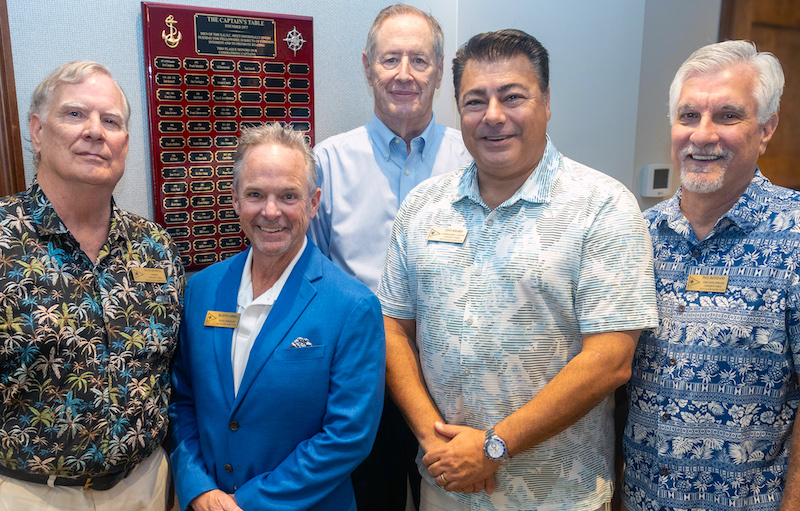
BREVARD COUNTY, FLORIDA — When it comes to heart health, Health First cardiologist Dr. Kevin Campbell, M.D., FACC, MBA, CPE, and Fleet Surgeon for the Eau Gallie Yacht Club, knows a steady rhythm matters — whether it’s the beat of a healthy heart or the pulse of waves against a hull.
Recently, he brought those two worlds together when he spoke at the Club’s Captain’s Table, a long-standing tradition where members gather weekly for fellowship and guest speakers.
A Yacht Club member for four years, Campbell enjoys sharing his expertise with fellow members, many of whom he considers close friends. With more than 20 years in cardiology — including at Duke University and the University of North Carolina, and the past five years with Health First — he focused his talk on one of the most common heart rhythm conditions: atrial fibrillation, or AFib.
Campbell began with the basics. The heart, he explained, usually beats in a smooth, regular pattern. The top part of the heart (the atria) works in perfect rhythm with the bottom (the ventricles) to pump blood through the body.
But in AFib that rhythm becomes irregular — what doctors call an “irregularly irregular” heartbeat.
“Instead of a steady thump-thump-thump,” Campbell said, “it’s more like a disorganized discharge of events, a flutter or a quiver. The timing is all off.”
When that happens, blood doesn’t flow through the heart as smoothly as it should. Sometimes it can pool inside one of the upper chambers, and when blood sits still, it can form a clot. If that clot were to break off and travel to the brain, it could cause a stroke.
“That’s why AFib is something we pay close attention to,” he said. “It’s not just the rhythm itself — it’s what can happen if we don’t manage it aggressively and make sure that we work to prevent stroke.”
AFib can feel very different from person to person. Some people feel their heart racing or fluttering in their chest. Others may feel lightheaded, short of breath, tired, or weak. And some don’t feel anything at all–they may be completely asymptomatic.
“Many people discover they have AFib by accident,” Campbell said. “They come in for a routine checkup or an electrocardiogram (EKG) and that’s when we see it.”

Symptoms may include fatigue, rapid heart rate, shortness of breath, chest pain, lightheadedness, dizziness and/or passing out.
He encouraged members to pay attention to their bodies.
“If you notice your heart beating strangely, or you feel more tired than usual, talk to your doctor,” he said. “Sometimes small changes can be the first clue.”
The good news, Campbell emphasized, is that AFib is very treatable. There are many ways to control it and greatly reduce the risk of stroke.
Treatment often begins with medications — some help keep the heart beating more regularly, while others thin the blood to prevent clots. But for many patients, modern procedures can correct the problem at its source.
Campbell explained a technique called catheter ablation, a minimally invasive procedure where doctors use thin tubes to reach the heart and gently correct the abnormal electrical signals that cause AFib.
“It’s like resetting the heart’s wiring,” he said. “It’s a high-tech way to bring the rhythm back in line — and most patients recover quickly.”
He also described the Watchman device, a small implant that blocks off the area of the heart where most clots form.
It’s a great option for patients who can’t take long-term blood thinners, and Health First Holmes Regional Medical Center recently celebrated its 1,000th Watchman implementation.
“These advances mean people with AFib can live full, active lives,” he said. “It’s all about finding the right treatment for each person.”
“At Health First, we believe that it’s vital to individualize care and meet the needs of each and every patient with AFib.”
Campbell also highlighted an important but often overlooked link between sleep apnea and AFib. Sleep apnea is a condition where breathing repeatedly stops and starts during sleep, often causing loud snoring or daytime fatigue.
“Sleep apnea puts extra stress on the heart,” he explained. “If you have AFib and untreated sleep apnea, it can make your heart rhythm harder to control. The good news is, treating sleep apnea often helps stabilize the heart rhythm.”

He encouraged anyone who snores, feels unusually tired, or has been told they stop breathing at night to get evaluated. “Fixing your sleep can help your heart — it’s all connected,” he said.
Throughout his presentation, members asked about everything from pacemakers and stroke prevention to options for people who struggle with CPAP machines.
Campbell stressed that good heart care is personal. “There’s no one-size-fits-all treatment,” he said. “We work together to find what’s right for you.”
As the discussion wrapped up, Campbell left members with a message that applies to both boating and heart health: Stay aware, stay steady, and always check your course.
“The earlier we detect AFib, the easier it is to treat,” he said. “When you understand what’s happening with your heart, you can take control of it, instead of letting it steer you.”
Events like this are what make Brevard County’s sense of community so special. “It’s great to have these conversations outside the clinic, where we can just talk openly and learn from one another,” he said.
Whether helping patients restore a healthy heartbeat or guiding fellow sailors toward smoother waters, Campbell’s message remains the same: steady rhythm, steady life.
 Related Story:
HOT OFF THE PRESS! September 29, 2025 Space Coast Daily News – Brevard County’s Best Newspaper














