Inside an Ayahuasca Retreat in Ecuador’s Amazon
By Space Coast Daily // August 31, 2026
Small groups, traditional ceremonies and life in the rainforest under the guidance of an Indigenous shaman with more than 60 years of experience
Deep in Ecuador’s Amazon region, beyond the noise of cities and familiar routines, an ayahuasca retreat follows a very different rhythm. Days begin with the sounds of the rainforest, while evenings are reserved for rest, preparation and, on selected nights, traditional ceremonies.
For international visitors, traveling to the Amazon may feel like a major step into the unknown. Yet the experience at Amayas is not designed as spiritual tourism or a single-night experiment. It is a structured seven- or eleven-day program that combines preparation, traditional ceremonies, personal attention, time in nature and periods of integration.
The retreat is guided by Indigenous Amazonian shaman Luis, who began learning about ayahuasca and traditional plant practices as a child. Now in his seventies, he has more than 60 years of experience with the medicine and continues a family tradition passed down by his father, Yachak Don Ramón.
An Ayahuasca Retreat Begins Before the First Ceremony
An ayahuasca retreat does not begin when participants enter the ceremonial space. Preparation starts before they arrive.
Guests receive information about diet, medications, health conditions and substances that may be incompatible with ayahuasca. This stage is important because the retreat is not suitable for everyone. Responsible preparation requires honest communication about physical and mental health, as well as a willingness to follow the retreat’s instructions.
After arriving in Ecuador, participants are transported from Quito to the Amazon region. The transition from the capital to the jungle is part of the journey. City streets gradually give way to mountains, rivers and dense tropical vegetation.
At the center, guests meet the team, settle into their accommodations and learn how the coming days will unfold. Groups are intentionally kept small, with a maximum of eight participants. This allows the shaman and assistants to pay attention to each person rather than managing a large, anonymous gathering.
Visitors considering an Ayahuasca retreat in Ecuador should understand that the experience involves more than drinking ayahuasca. It includes preparation, ceremonies, rest, individual traditional cleansing and time to process what arises.
The Ceremonial Setting
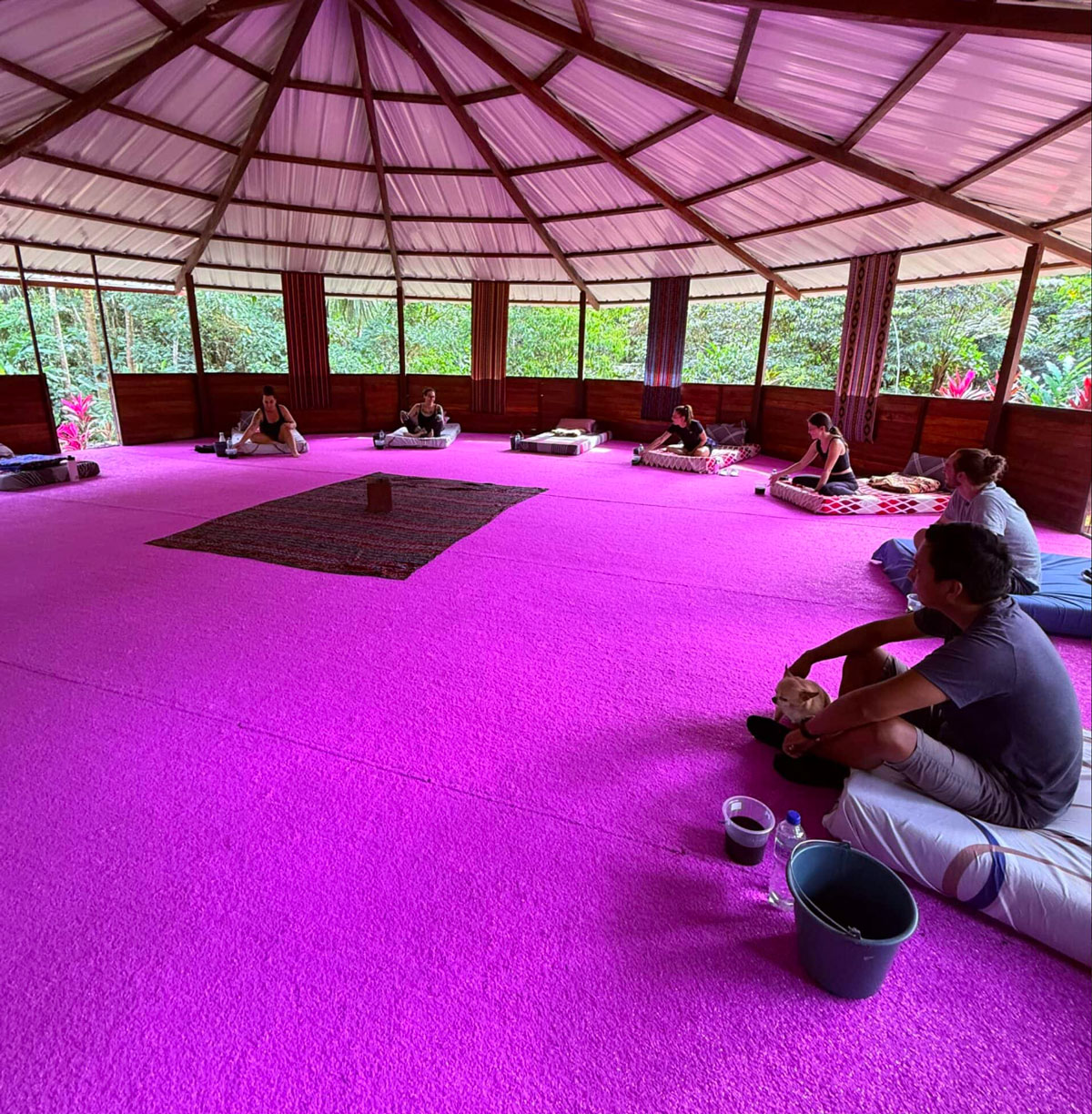
Ayahuasca Ceremonies take place in a traditional open-sided structure known as a maloka. Located within the jungle, it provides protection from the weather while remaining connected to the sounds and atmosphere of the rainforest.
Mattresses are arranged in a circle, and each participant has a personal place to sit or lie down. The ceremony begins at approximately 8:30 p.m. A candle may provide the only light before the room becomes dark and quiet.
Unlike modern ceremonies that incorporate recorded music or a continuous program of entertainment, the approach at Amayas is deliberately simple. Silence is an important part of the practice. Participants are encouraged to remain focused on their own process rather than being distracted by external stimulation.
The shaman also drinks the medicine and observes the group throughout the night. Experienced assistants remain present to help participants when necessary. Guests are not expected to navigate the ceremony alone.
The initial serving is intentionally moderate. The effects may begin within 15 minutes for some people, while others may wait considerably longer. If someone feels that an additional serving is appropriate, it is discussed with the shaman rather than taken automatically.
A traditional Ayahuasca ceremony may continue for several hours. With a small group, the night often concludes at approximately 3 a.m. Participants can then remain in the maloka or return to their accommodations to rest.
Individual Attention During the Night
One of the central elements of the Amayas approach is individual cleansing. During each ceremony, Luis spends approximately 25 to 30 minutes working personally with every participant.
Within his tradition, this work may include icaros—traditional healing songs—as well as mapacho tobacco, aromatic plant essences and other cleansing practices. The purpose is not to provide a performance for the group. It is a focused part of the participant’s individual process.
Once the personal cleansing is complete, the participant returns to their mattress and has time to remain quiet. There is no pressure to immediately explain or analyze the experience.
Amayas generally recommends participating in several ceremonies rather than seeking a single encounter. The program is designed so that each ceremony can build upon the previous one, with rest and integration between them. Guests are also advised not to move between different shamans during the same retreat, since each practitioner may work with a different method and tradition.
What Happens Between Ayahuasca Ceremonies?
An Amazon ayahuasca retreat is not composed only of nights in the maloka. What happens during the day can be equally important.
Some mornings are deliberately quiet, allowing guests to sleep, write, reflect or spend time alone. On other days, the program introduces participants to the wider landscape and culture of Ecuador’s Amazon region.
Depending on the selected retreat, activities may include river journeys, waterfalls, caves, thermal baths, a visit to a Kichwa community, traditional chocolate production or guided rafting. Before selected ceremonies, participants may also experience an Amazonian herbal sauna.
These activities are optional. Anyone who needs additional rest can remain at the center rather than following a rigid tourist schedule. This flexibility matters because every participant responds differently to the physical and emotional intensity of the retreat.
Time in nature also helps create a healthier balance. Instead of spending the entire program concentrating on visions or expectations, guests can walk, swim, observe the rainforest and reconnect with ordinary physical experience.
Tradition Without Spiritual Tourism
Ayahuasca has become increasingly visible around the world, but greater popularity has also brought commercialization. Short ceremonies are sometimes marketed as exotic adventures or instant transformations.
The philosophy at Amayas is different. The center does not accept guests who simply want to try ayahuasca for one night as a recreational experience. Its retreats are intended for people prepared to approach the tradition seriously and respectfully.
No responsible retreat can promise a particular vision, emotional breakthrough or medical result. Experiences vary significantly. Some nights may be intense, while others may be quiet. The value of the process cannot be measured only by dramatic moments.
What the center can provide is structure: a small group, an experienced shaman, trained assistance, preparation, traditional ceremonies and enough time between them for rest and reflection.
Returning Home Is Part of the Journey
The ayahausca retreat does not truly end with the final ceremony. Before leaving the Amazon, participants are encouraged to consider how they will carry the experience into everyday life.
Integration may involve rest, journaling, changes in routine, continued reflection or professional support when appropriate. The goal is not to remain attached to an extraordinary experience but to understand whether anything learned during the retreat can be expressed through practical choices.
In this way, the journey through Ecuador’s Amazon becomes more than a collection of ceremonies. It is a period of slowing down, listening and stepping away from familiar patterns—guided by a living tradition that has been carried through generations.