Atlantic Hurricane Season is Here: Health First’s Space Coast Hospitals are Ready
By Space Coast Daily // June 17, 2024
Every detail, scenario and need is planned well in advance of tropical storm season
 Related Story:
Adventist HealthCare CEO Terry Forde Named President and CEO of Health First in Brevard County
BREVARD COUNTY, FLORIDA – The 2024 hurricane season is 20 years removed from the historic 2004 season that lashed the state of Florida with four major hurricanes in just six weeks. This season is also widely predicted to be an exceptionally busy one.
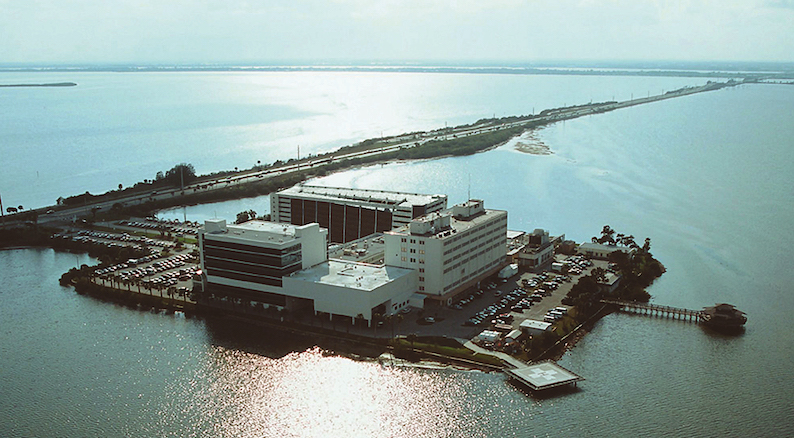
With four hospitals dotting the Atlantic coast in Brevard County – including Cape Canaveral Hospital, just a mile inland – Health First leaders, physicians, nurses and staff regularly drill and plan for the realities of a destructive storm.
From stocking supplies, adjusting surgical and office visit schedules, and enacting facility closures, to staffing, evacuations and a return to normal business operations, every detail is planned for each year in advance of the six-month storm season to ensure patients, associates and visitors are safe, and that resources and critical media services are available to the community once a storm passes.
According to Wayne Struble, Health First’s Director of Emergency Preparedness, the system drills each year for the tropical season that spans from June through November, and those drills encompass everything from stocking supplies and securing facilities to evacuating Cape Canaveral Hospital.
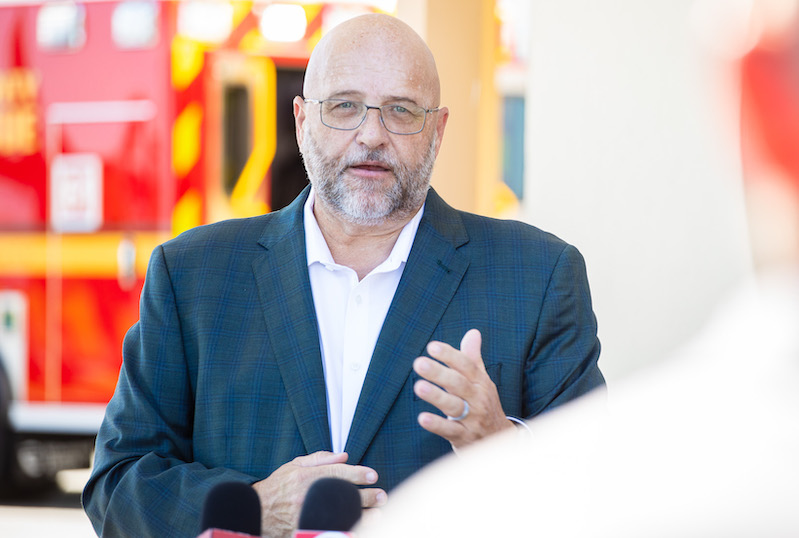
“We’re faced with the reality of a dangerous natural disaster affecting our hospitals and healthcare system – and the communities we serve – for at least half of every single year, so we must be prepared at all times. We have multiple checklists and typically start preparing days before expected landfall of an approaching storm,” he said.
Communication is Key
Struble says that a common misconception is that Cape Canaveral Hospital, which sits on a barrier island approximately a mile from the Atlantic, evacuates each time there is a hurricane warning. That’s not the case, as evinced in 2022 when Brevard County experienced two hurricane warnings yet did not need to evacuate the hospital.
In fact, the last time Health First evacuated the facility was in Sept. 2019 for Hurricane Dorian, which looked like it was on track for a direct strike just south of Brevard County before turning north and skirting Florida’s east coast.
“For us to evacuate, if it’s an East Coast-approaching storm that we feel is pretty significant, we talk to Brevard County Emergency Management and the state, and they decide whether or not to evacuate the barrier islands,” he said.
If an evacuation is ordered, the hospital is evacuated, and “we plan for that potential each storm we face,” he said.
Health First is not only the county’s largest healthcare system but one of its the largest employers.
“Communication is key,” said Struble.
“Whether it’s visitors of patients, the patients themselves, or even patients who have upcoming procedures or appointments, we communicate what we’re doing through many channels, directly and indirectly, including the news and social media – especially when we’re going to evacuate.
“We want our patients to be as prepared as possible, just as we’re preparing. It’s a very big deal to relocate patients from one place to another in just a few hours. We try to discharge patients who receive discharge orders. With high winds approaching and potential flooding and road closures, we try to get them out as quickly and safely as possible.”

As part of preparation details, supplies get an extra layer of attention as a host of unknowns must be considered – from road closures and damaged infrastructure to power outages and supply chain disruptions.
“We start meeting at individual hospitals and facilities, and collectively as a system. We discuss our operational plans, staffing, facility needs, power generator updates, everything down to the last detail – having enough food, water and supplies for patients, staff and visitors, linens, everything. We’re talking to our vendors. We make sure we get extra supplies. In fact, we make sure we are stocked with 96 hours of supplies – then we add an additional 20%.”
Rick Desmond is a facilities and construction manager at Health First. He and his team must be on site at every hospital campus during a hurricane, whether it evacuates or not.
“A hospital is a 24-7 facility, so no matter what happens, we’re here to support and respond as necessary in order to be fully operational for our communities before, during, and after a storm passes,” he said.
“We constantly prepare throughout the year. We have our generators that we run monthly checks on. In terms of water situations, we’ve actually lost water here before on campus. But we can have water trucked in. No stone goes unturned in terms of our needs to prepare.”
But despite being in place since the early 1960s, Cape Canaveral Hospital has never suffered serious damage.
“We’ve never had any real damage to Cape Canaveral Hospital. We’ve had some damaged façades, a canopy, some minor structural issues with that, but other than that, that’s the only major damage that we’ve ever had here. It’s held up very, very well.”
“In the end, the most important thing we keep in mind is taking care of what we have here – our people first and the facilities and equipment second.”

State-of-the-Art Hospital
Health First in March announced plans to build a new, state-of-the-art Cape Canaveral Hospital four miles from the ocean that is designed and will be built to withstand at least a Category 4 hurricane and catastrophic localized flooding.
The new 268,000-square-foot Cape Canaveral Hospital, slated to open early in 2027, will include:
■ 120 private inpatient beds.
■ 25 Emergency Department treatment rooms
■ 6 Operating Rooms
Continuation of care and the potential for evacuation will be evaluated for individual storms in consultation with state officials. Additionally, the entire campus site will be constructed 13 feet above sea level to withstand storm surge. The campus will also be served by an on-site Central Energy Plant built to ensure continuous power function even during tropical storms and hurricanes.
The campus will feature ample parking, including 296 paved/surface parking spots and 533 covered/structure parking spots. The three-deck parking structure and surface parking spots will provide easy and convenient access within the campus. The plans include a new three-story, 92,000-square-foot Medical Office Building.

Go to HF.org/news for the latest news about Health First.