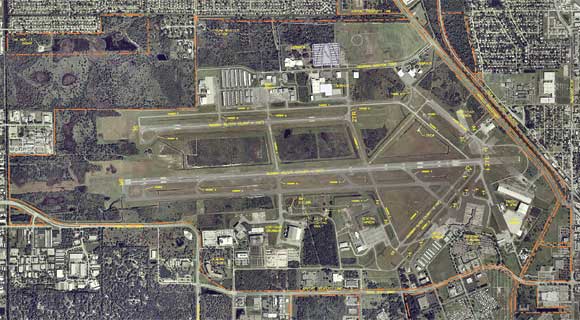
Melbourne Orlando International Airport Started as Air Mail Fueling Stop in 1928, Now Major Economic Driver and High-Tech Hub
By Space Coast Daily // June 10, 2026
MLB is public airport governed by seven-member board appointed by the Melbourne City Council
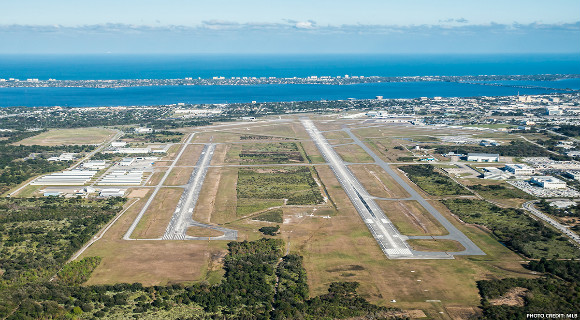
Melbourne Orlando International Airport is now an award-winning airport, crowned #1 Most Scenic Airport in North America.
BREVARD COUNTY • MELBOURNE, FLORIDA – Melbourne Orlando International Airport (MLB) has a rich history on the Space Coast and has become a major economic driver and high-tech hub since its founding almost 100 years ago.
Melbourne Orlando International Airport is an award-winning airport, crowned #1 Most Scenic Airport in North America by PrivateFly.com, and serves as the Coastal Gateway to Central Florida.
Air service growth has spurred a major terminal project that will deliver an enhanced travel experience for all airport customers.
MLB is globally recognized as an epicenter of aerospace, home to Northrop Grumman, L3Harris, Embraer, Collins Aerospace, and more.
In addition to evolving air service from Delta Air Lines and American Airlines, Allegiant has routes to Pittsburgh, Nashville, and Concord, N.C., and MLB has become TUI UK’s gateway to Florida.
MLB’s $72 million Terminal Renovation and Expansion Project included the addition of 86,000 square feet of new facilities, including a security checkpoint, an expanded departure area with new gates, restaurants, retail options, and furniture, an expanded international baggage claim, a welcome center, and four sets of restroom facilities.
MLB is a public airport governed by a seven-member board appointed by the Melbourne City Council and the private sector, led by executive director Greg Donovan, A.A.E.
The airport budget is part of the Melbourne municipal budget, as the airport receives no local tax dollars.
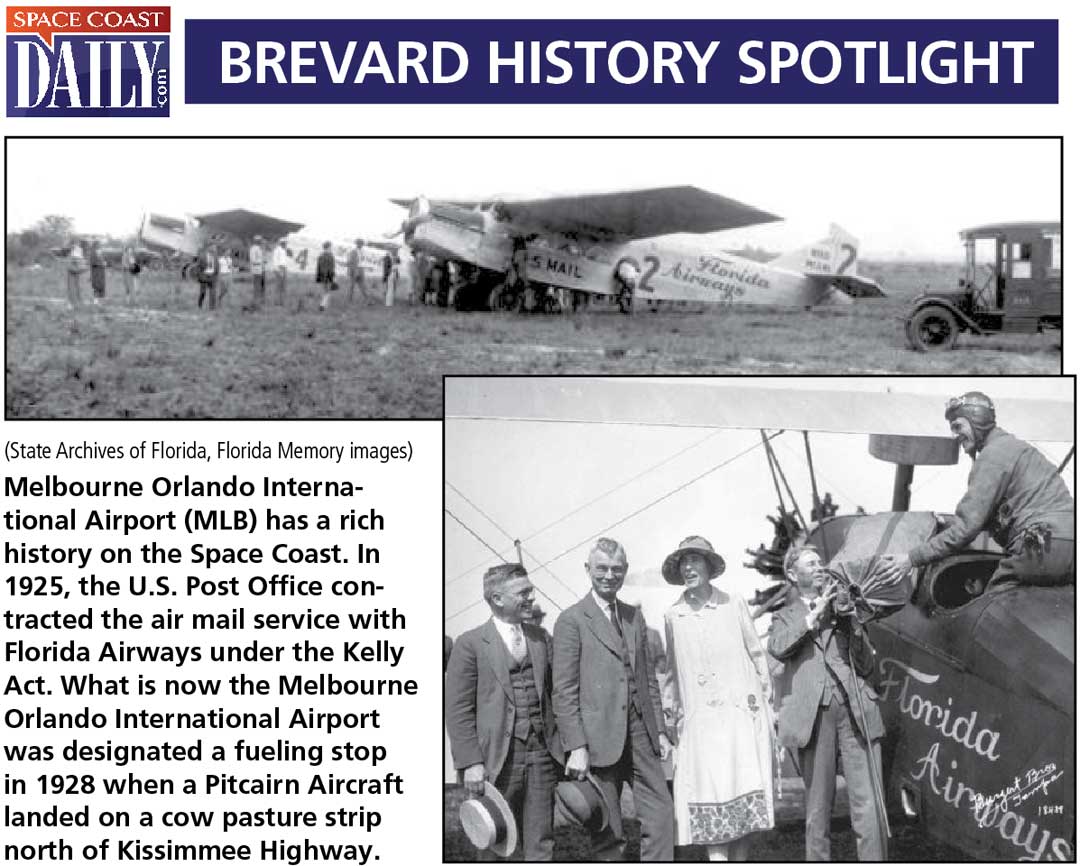
Began as an Airmail Fueling Stop
Melbourne International Airport began in 1928 when a Pitcairn Aircraft landed on a cow pasture strip north of Kissimmee Highway. Airmail service started in late 1928 when the airport was designated a fueling stop.
In 1933, the City of Melbourne acquired 160 acres west of Indian River Bluff to develop as a new airport, which was later operated as Naval Air Station Melbourne during World War II.
Returned to the city as a Surplus Property Airport after the war, Melbourne Airport was deeded to the city in 1947. It was a municipal airport until 1967, when the city created the Melbourne Airport Authority to plan, operate, maintain, and develop the airport, then called Melbourne Municipal Airport.
The airport was originally named Cape Kennedy Regional Airport, and city officials changed the name to Melbourne Regional Airport in 1973 to better reflect its role.
In January 1951, the airport had runways 04/22, 09/27, 13/31, and 16/34, all being listed as being 4,000 to 4,300 feet long, and scheduled airline flights began in 1953.
The April 1957 Official Airline Guide listed four Eastern Airlines departures, Martin 4-0-4s to Vero Beach, Daytona Beach, and Jacksonville.
National Airlines arrived in 1959 with Douglas DC-6Bs and scheduled the first jet airliner flights in 1963: Douglas DC-8s on the routes Miami-Melbourne-New Orleans-Houston-Los Angeles and Los Angeles-Houston-Melbourne-Miami.
In 1960, Meadowlane Elementary School opened at a Naval hospital on the airport grounds, and it moved to West Melbourne in 1961.
In 1969, a National DC-8 flew from Los Angeles to Tampa, Melbourne, and Miami. Houston and Los Angeles were part of NASA’s space program, and Melbourne was close to NASA’s Kennedy Space Center.
In July 1974, a National Boeing 727 flew Miami-Melbourne-Tampa-New Orleans-Los Angeles-San Diego; National Boeing 727-200s flew direct from Houston and New Orleans to Melbourne. In May 1979, National had one daily flight from Melbourne, a 727-200 to Tampa.

Serving the ‘Space Corridor’
In the late 1960s and early 1970s, Eastern Airlines Boeing 727s, Douglas DC-9s, and Lockheed Electras flew out of the airport.
In June 1967, Eastern announced “The Space Corridor” from Melbourne to three centers in the space program: Huntsville, Alabama, St. Louis, and Seattle.
Eastern’s “Space Corridor” was a Melbourne-Orlando-Huntsville-St. Louis-Seattle Boeing 727-100.
In June 1967, Eastern flew nonstop from Melbourne to Atlanta, Tampa, and Ft Lauderdale and direct to New York City (JFK Airport), Washington, D.C. (Dulles Airport), Boston, and Miami.
In February 1976, Eastern flew a 727 nonstop from Los Angeles to Melbourne via Atlanta; the route was eventually dropped when the airline closed in 1991.
In the early 1980s, some ending scenes for the film Stranger Than Paradise were shot in the Melbourne area, including several plot scenes shot at the airport.
People Express Airlines started nonstop service to Newark, Baltimore, Columbus, and Buffalo, New York, in spring 1982 using Boeing 737 jets. They eventually scaled back to just nonstops to Newark and ended service to MLB in 1986.
Delta Air Lines started nonstop service to Atlanta in 1983 with DC-9s and later upgraded to Boeing 737s and MD-80s.
The Authority operated a recreational vehicle site, “Port O’ Call,” which was closed in 2003 to allow the property to be used for commercial development. The Melbourne Airport Authority operates Tropical Haven, a 760-site manufactured home park.
In 2010, the airport had nonstop flights to Atlanta on Delta Air Lines and regional partner Atlantic Southeast Airlines, as well as nonstop flights to Charlotte Douglas International Airport on US Airways’ regional subsidiary, PSA Airlines.
These flights continued in 2019 on Delta and American. Delta used to fly nonstop from Melbourne to its hubs in Cincinnati, New York-JFK, and New York-La Guardia, as well as to Washington-Dulles and Washington-Reagan; all of these flights were discontinued.
Elite Airways began operating at the airport in 2014 with flights to Washington Dulles International Airport.
The airport’s first scheduled international service was announced by Porter Airlines in September 2015 to Toronto’s island airport. The airline discontinued service to the airport in 2019.
In 2017, a $20 million upgrade was proposed for the airport, with 90 percent funded by the FAA, almost $1 million by the FDOT, and $1 million by the airport.
In November 2019, British tour operator and airline TUI Airways announced that it would switch its Orlando operations from its current base at Sanford to Melbourne.
This announcement saw a total of 17 weekly flights to/from 8 British airports and will bring their operations nearer to Port Canaveral, where TUI’s Marella Cruises will sail from in the coming years.